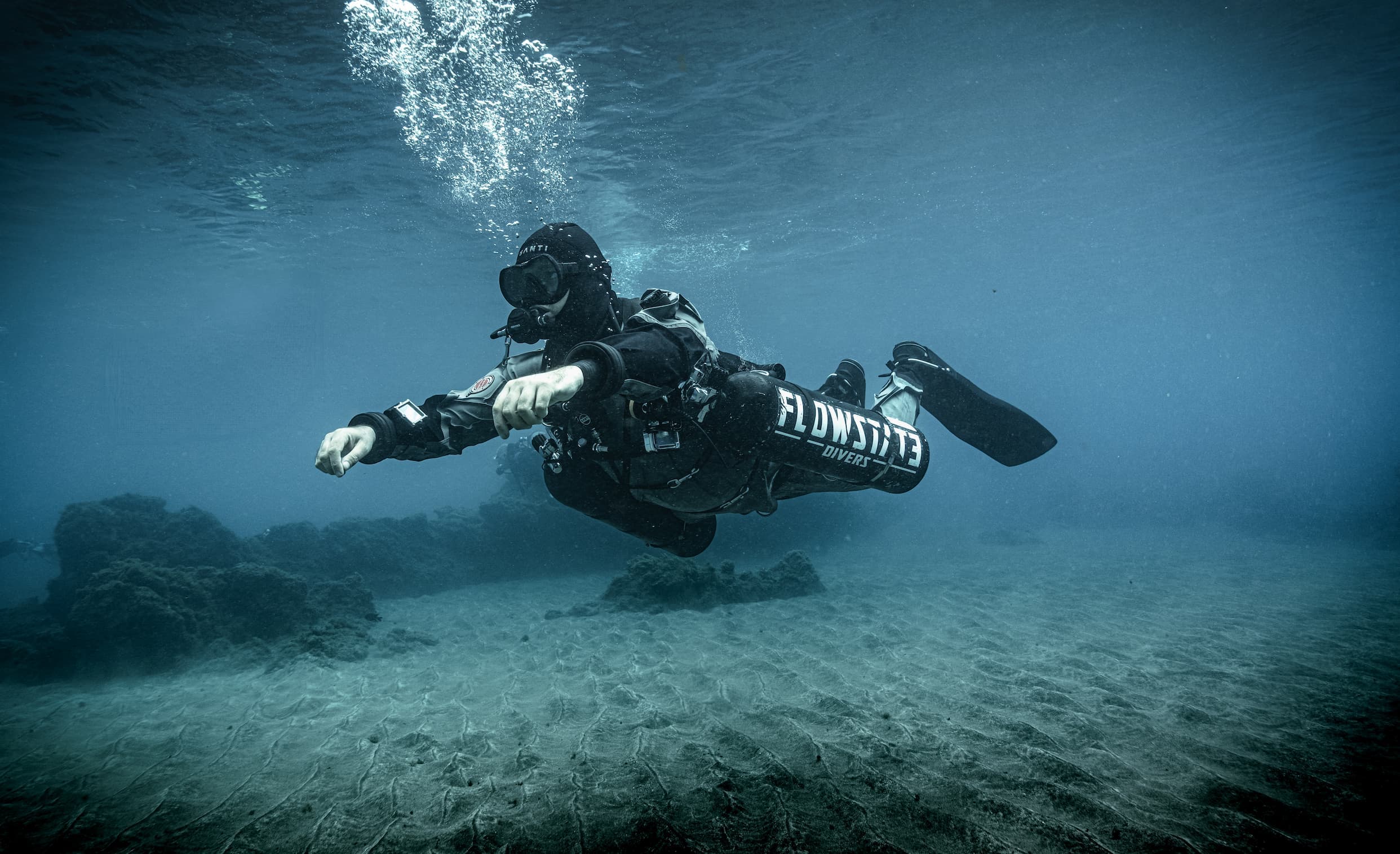
Sidemount
Two cylinders at your sides - redundancy, trim, and gas management as one configuration.
curriculum
Who is this for
Sidemount suits divers whose diving actually calls for cylinders at the sides - and who know this is not a configuration you simply put on and call done. It is a delicate platform: it asks for deep understanding before the kit disappears into craft, and plenty of diving after the training so the skills stick instead of fading into a novelty.
If you want a configuration weekend for photos, stay away; if you will live in this kit, Sidemount is for you.
Who Is This Not For
It is not for a weak mind, for those who want a quick result, or for divers who cannot cope with failure. Sidemount digs where the challenge is sharpest - trim and cylinder position as gas depletes, valve drill when a side fails, and rescue while your own kit must stay under control - and it will find those fault lines. If you are not fit for that work, stay away. Standards are the filter - not scarcity theatre.
Where Sidemount sits
Sidemount is a configuration module of XTEND. It assumes everything confirmed in Genesis through Driftar and Velari - mentality through dive leadership, plus team execution on a real site - and confirms harness and hose routing, entry and exit, weighting and trim with cylinders at the sides, valve drill, gas sharing, dynamic cylinder management, and rescue. Furian is not required. Twinset uses the same entry and is a separate configuration, not the next Sidemount module - XTEND modules are not sequential with each other. Stage needs the full XBASE chain and XPERIENCE through Deyron.
Later training adds complexity; it does not replace what is built here. Skip it only through an assessment day that proves the same gates.
Sidemount · questions
Frequently asked questions
XBASE Genesis through Driftar with a FlowState Divers mentor, plus Velari. Open Water certification from any recognised agency and valid scuba insurance still apply. Online learning material is sold separately and is not included with in-person training. In-water skills are confirmed with your mentor. If you trained elsewhere, your mentor schedules an assessment day covering every missing module before training days begin.
XTEND modules are not sequential. Twinset uses the same entry as Sidemount - XBASE Genesis through Driftar and Velari. Stage needs the full XBASE chain and XPERIENCE through Deyron. Completing Sidemount confirms the nine configuration skills; it is not a gate for Twinset.
Hold off on buying a sidemount harness before the training. Many products lack the adjustability of the systems we support. During the training you try configurations with your mentor, who helps identify a model that fits how you dive.
If you already own a harness, bring it. If it is a system we support, your mentor will configure it and you will train on that unit.
Choose the configuration you will dive and confirm you hold its entry standard. Sidemount and Twinset require Open Water certification, valid scuba insurance, XBASE Genesis through Driftar, and Velari. Stage requires the full XBASE chain and XPERIENCE through Deyron.
Then choose a FlowState Divers mentor (see available options here). Online learning material is sold separately and is not included with in-person training. Online coaching opens by application after you have purchased and studied the materials. In-water skills are confirmed with your mentor in the water. If you trained elsewhere, your mentor schedules an assessment day covering every missing XBASE module before training days begin.
No. XTEND modules are not sequential with each other - start with the configuration you will actually dive. Each one has its own cross-bundle prerequisites, though: Sidemount and Twinset need XBASE Genesis through Driftar and Velari; Stage needs the full XBASE chain and XPERIENCE through Deyron. Your mentor confirms you meet them before training days are scheduled.
Yes, as two separate steps. Each XTEND module's online learning material is purchasable with lifetime access; buying it does not enroll you in coaching. After you have studied the materials, you apply for online coaching. In-person training does not include online learning material. The in-water skills - rigging, valve drills, gas sharing, trim checks, rescue - are confirmed with your mentor in the water.
FlowState Divers requires a minimum equipment set that must adhere to our standards. Some programmes have special equipment requirements that you need to verify on that programme's page before you start training. For the generic equipment list, check out our standards.
To train with FlowState Divers, you are required to be a certified diver. The minimum certification accepted is the Open Water Diver certification from any recognised agency.
In order to train with FlowState Divers, it is necessary to have valid scuba diving insurance that is recognised in the country where you will be completing your in-person training. If you do not currently possess insurance, it is advisable to contact your mentor prior to booking your training to explore your options. Your mentor may be able to assist in arranging suitable insurance, or they may provide guidance on the specific insurance requirements for the country in which your training will take place.