
Participation Is Optional. Capability Is Not.
Scuba diving is often framed as accessible, gentle, and universally achievable. That framing is convenient. It fills boats and courses. It lowers friction.
It is also incomplete.
Diving is not dangerous because it is extreme. It is dangerous because it punishes unpreparedness without warning. The environment does not escalate emotionally. It simply removes margins until what remains is capability - or its absence.
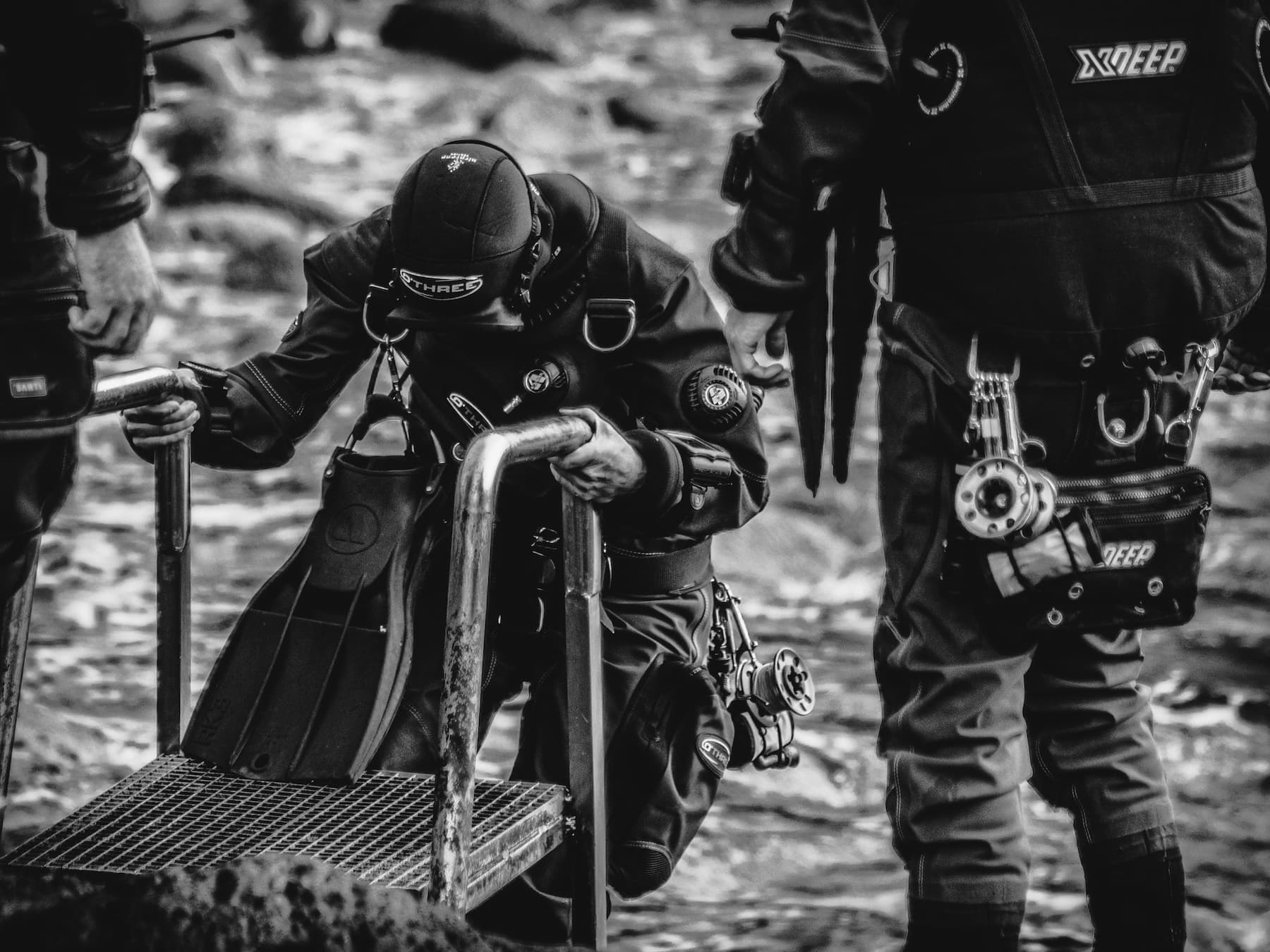
At FlowState Divers, we reject the idea that diving is for everyone by default. Diving is for those who are prepared to operate, not merely participate. Fitness is not a lifestyle accessory to diving. It is one of the conditions that makes safe, reliable diving possible at all.
We don't train for successful dives. We train for failed assumptions.
Participation vs. Capability
Most divers are trained to perform skills in isolation, under favourable conditions, with problems arriving one at a time. That is participation-level competence.
Operational diving is different. Tasks overlap. Stress compounds. Effort increases unexpectedly, and someone else may become the priority.
Fitness is what allows a diver to remain functional when the script collapses.
It is the difference between executing a rehearsed response and sustaining performance while the environment applies pressure. When physical capacity is marginal, even simple tasks begin to compete for attention. Breathing, buoyancy, positioning, awareness - each draws from the same limited reserve. Once that reserve is depleted, performance degrades rapidly, and decision-making follows.
Think of your last dive where exertion surprised you. What degraded first?
A diver who only functions when conditions are ideal is not operational—they are tolerated by the environment until they are not.
What the Environment Demands
Water is not neutral. It resists movement, accelerates heat loss, alters balance, and imposes artificial breathing. Even in calm conditions, the body is already compensating.
Fitness is not about excelling. It is about not degrading when effort increases.
Cardiovascular Capacity: Control Under Load
Breathing is the first system to break down under stress. Each quick inhale, shallow exhale, or spike in heart rate immediately affects the body and the environment around it. Out-of-control breathing doesn’t just burn gas faster - it destabilises buoyancy, and undermines the subtle balance that keeps a diver suspended. When breath falters, movements lose accuracy, and energy is wasted simply to stay in position. Poor breathing triggers poor movement, which fuels stress, creating a cycle that compounds with every second underwater.
A diver with adequate aerobic capacity maintains slow, controlled breathing under workload, recovers more quickly after exertion, and preserves fine control of buoyancy throughout. This isn't about endurance for its own sake. It's about preserving cognitive bandwidth and operational control when physical demand rises. Breathing is your anchor, your throttle, your silent interface with the water itself.
If breathing control disappears, decision-making follows. If buoyancy collapses alongside it, the diver is no longer just at risk—they're actively compromising their own safety and that of others. Cardiovascular fitness, in this sense, isn't optional. It's the primary tool for managing both body and environment simultaneously.
Strength: Functional, Not Performative
Diving strength is not about how much you can lift in a gym or how defined your muscles look in a mirror. It is situational. It reveals itself in moments that demand more than skill, moments where your body must act as a tool, a support system, a stabilising force.
It shows up when you carry a full set of equipment across rocky, uneven terrain while the ocean pulls at your feet and waves crash unpredictably. When you must stand upright in full gear after a surf entry, legs trembling, water tugging at every strap and tank. When you climb a ladder into a boat in surge, balancing weight, momentum, and exhaustion simultaneously. When you stabilise, tow, or support a teammate whose panic, injury, or fatigue has suddenly shifted the responsibility onto you.
These are not hypothetical scenarios. They are the moments that decide whether a dive ends in calm competence - or in chaos. Picture a diver at the surface, breathing hard after a long swim, waves lifting and dropping the boat ladder. Nothing dramatic has happened yet - but the margin is already thinning. Technique, practice, and skill will take you only so far. When the unexpected arrives, strength becomes the safety margin between action and failure.
A diver who cannot reliably manage their own mass and equipment cannot be expected to manage someone else’s. This is not a question of ego, courage, or intent. It is physics. Mass, leverage, fatigue, resistance - these laws do not bend for desire or willpower. They only respond to preparation.
Functional strength is quiet. It doesn't show off or demand recognition. But when it's absent, its absence is loud, immediate, and unforgiving. For the diver who values reliability, competence, and safety above all, strength is non-negotiable.
Mobility and Efficiency
In the water, every movement carries a cost. Every kick, every turn, every adjustment consumes oxygen, energy, and mental focus. Efficient divers waste little; inefficient divers expend far more than the environment demands, and every wasted motion chips away at control, calm, and composure.
Mobility is the foundation of that efficiency. It allows a diver to maintain stable trim so the body flows through the water rather than fighting it, fin with precision and power by channeling energy into forward motion rather than lateral drift, reduce the workload on breathing to keep oxygen in reserve for when it's truly needed, and move predictably, smoothly, and deliberately even when currents, surge, or emergencies demand adaptation.
Rigid bodies fight the water, creating turbulence that demands more gas, more effort, more attention. Flexible bodies move with the water, not against it. They conserve energy, maintain position, and act without noise or strain. Every joint that bends freely, every muscle that engages without tension, is a small victory over chaos.
True efficiency is invisible, quiet, and deliberate. You feel it in the space you create for thought, awareness, and decision-making—where the water ceases to be a burden and becomes an extension of action.
The Myth of Universal Suitability
“Diving is for everyone.” It’s a comforting phrase. It makes courses sell, makes people feel included, and reassures those who want the ocean without the effort. But in practice, it is a lie that erodes accountability.
Not everyone is fit to dive - right now. Not everyone is capable of handling the weight of themselves, their equipment, and the consequences of someone else relying on them. Ignoring this fact does not make it disappear. It simply moves danger from the individual to the team, from preparation to improvisation, from competence to luck. And luck is a cruel teacher underwater.
This isn't about exclusion. It's about honesty. Diving demands minimum operational readiness. You don't need to be a bodybuilder or an elite athlete, but you do need to be strong enough, fit enough, and aware enough to handle exertion, manage risk, and recover under pressure. Anything less isn't adventure—it's an invitation to failure.
At FlowState Divers, fitness is stripped of ego. It's not a measure of identity, desire, or bravado. It's a measure of readiness. Are you capable of operating when conditions shift, when stress accumulates, when someone else depends on you? If the answer is anything less than confident, the ocean isn't a playground. It's a test—and it will fail those who are unprepared.
The modern dive industry optimises for accessibility; the ocean optimises for reality.
This isn't accidental. It's structural. Accessibility sells, preparation costs time, and time reduces throughput. Reduced standards become "inclusive philosophy." The system rewards volume, not readiness. Instructors are incentivized to pass, not prepare. Agencies avoid hard requirements because hard requirements reduce enrollment. The result is an industry that optimizes for participation while the ocean optimizes for reality. The gap between these two optimizations is where accidents happen.
Fitness as a Team Obligation
When conditions are calm, this interdependence is easy to ignore. But when stress enters the system - current, fatigue, equipment failure, panic - fitness stops being personal. It becomes operational. Your physical capacity directly affects the survival margin of the people around you.
If you cannot assist an exhausted diver without losing control yourself, maintain physical and mental stability under stress, or accept increased workload without spiraling into panic, then you are not a neutral presence in the water. You are a liability. Not because you are careless, but because your capacity is insufficient for the role you have implicitly accepted.
If your teammate had failed at minute 35, would your body have been an asset or a drag?
This isn't about heroics. It's not about dragging someone through impossible conditions or performing dramatic rescues. It's about baseline reliability—the ability to function when the environment demands more than comfort. A reliable diver doesn't need to be exceptional. They need to be predictable, stable, and capable when it matters.
Fitness is part of the contract you sign with your team the moment you submerge. You are declaring, without words, that you can carry your own weight - and, if necessary, help carry theirs. Breaking that agreement is not a personal failure. It is a systemic one, and the system underwater is unforgiving.
Divers who ignore fitness make a silent bargain: they outsource risk to teammates, rely on benign conditions, and confuse "nothing went wrong" with competence. The avoidance patterns are predictable. "I'll just stay shallow." "I won't dive in current." "My buddy is strong." "I've never had a problem." These are industry-normalized coping mechanisms, but they're also ways of transferring responsibility to others while maintaining the illusion of self-reliance.
The purpose of this isn't to disqualify divers. It's to return agency to them. Capability isn't reserved for a few—it's built deliberately, step by step, by those willing to face reality without distortion.
Here is a pattern that repeats. A diver enters the water with marginal fitness. Conditions are calm, nothing dramatic happens, and they complete the dive. They complete ten dives, then a hundred. Then conditions shift—current, surge, distance, equipment failure, teammate distress. The margin that was always thin becomes absent. The body that was always marginal becomes a liability. The diver who was always conditional becomes a problem. This isn't a story about one person. It's a pattern. The ocean doesn't care how many successful dives preceded the one where capacity was insufficient.
Operational Self-Assessment and the Psychology of Readiness
Fitness does not need to be abstract, theoretical, or filtered through self-image. It can - and should - be assessed in simple, concrete terms. Operational readiness is not about how you feel on your best day; it is about what your body can reliably deliver when conditions are imperfect.
A diver who is fit for operational diving should be able to swim several hundred meters continuously at a steady pace without distress, sustain moderate finning effort for extended periods without losing breathing control, carry, don, and manage their equipment confidently and repeatedly, regain calm, controlled breathing quickly after physical exertion, and move safely and deliberately in full gear across unstable or uneven surfaces.
These aren't elite benchmarks. They don't represent excellence or mastery. They're entry conditions for reliability—the minimum physical capacity required to participate in a team environment without becoming a limiting factor when effort increases.
If any of these feel marginal, that is not a verdict - it is information. At FlowState Divers, this is where mentorship begins. The response is not to rationalise limitations or lower expectations, but to prepare deliberately. Fitness is trainable. Capacity can be built. What matters is the willingness to confront reality honestly and act on it.
This matters because physical readiness and psychological stability are inseparable underwater.
Physical unpreparedness amplifies psychological stress in a predictable sequence: poor fitness increases effort, which destabilises breathing, which drives anxiety, which narrows perception and erodes judgment. This cascade is not a character flaw - it is a physiological response to overload.
Fitness doesn't eliminate stress. Diving will always involve uncertainty and pressure, but fitness buffers it. A capable body gives the mind space to observe, prioritise, and decide. It preserves situational awareness when demands stack and time compresses.
Calm isn't a personality trait. It's not something you summon through willpower alone. Calm is a physiological outcome of preparation. It emerges when the body is capable enough that it doesn't dominate attention.
This is the mentor philosophy: build the body so the mind can work. Fitness isn't about proving worth or meeting arbitrary standards. It's about becoming a diver who can think clearly, act deliberately, and remain dependable when others need you to be.
Operational readiness is not optional in diving. It is the price of participating in an unforgiving environment - and the cost of ignoring it is never paid alone.
Fitness ignored is risk transferred. Risk transferred is betrayal of the team. The ocean doesn't arbitrate intent. You now know this. You don't get to unknow it.