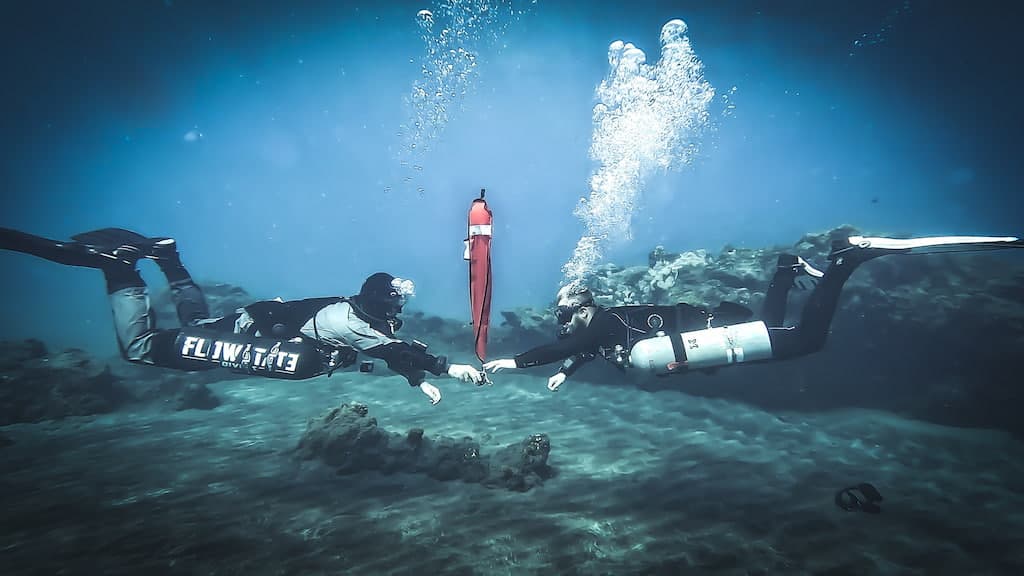
XBASE - The Brutally Honest Path to True Diving Mastery
They say “smooth seas never made a skilled sailor” - and the same holds true for divers. Typical scuba courses are mostly ritual. A dozen students follow one instructor, copying skills in calm, shallow water, ticking boxes, and walking away with a certification card. It may feel like progress - but it’s an illusion. Practising in perfect conditions doesn’t build real competence. A checklist is not the same as habits you can rely on when something fails, visibility drops, or your team needs leadership.

That’s the gap the FlowState Divers - XBASE Program Bundle was designed to close. XBASE is not about chasing yet another certificate. It’s about rebuilding a diver who thinks, trains, and responds with true competence and someone who can continue to improve on their own. It’s private, intense, and uncompromising. It demands time, fitness, curiosity, and humility. In return, it gives something that a weekend certification never can: procedural thinking, durable skill, and a practice framework that survives long after the last training dive.
Below, I’ll walk you through why XBASE feels so different, what the six-module structure looks and feels like in practice, the pedagogy behind the program, how to prepare physically and mentally, the real challenges you’ll face, and how to turn this training into a lifelong habit.
Why XBASE Is Unlike Anything Else in Diving
Most mainstream courses are designed for efficiency at scale. The formula is familiar: an instructor demonstrates, a group copies, and a “pass” is awarded once everyone can mimic the move one way or another. While effective for churning out certifications, this approach prioritises imitation over real understanding and rewards the bare minimum required to get through the checklist. The outcome is predictable - a diver who may look proficient in calm, rehearsed conditions but lacks the self-awareness, adaptability, and structured learning tools to keep improving once the course is over.
XBASE was created to be the antidote to this. It isn’t just “another course” - it’s a complete reimagining of how divers should be trained. At its core, it is private, one-on-one (or within a very small pre-existing team of up to three members), ensuring that every detail of a diver’s performance is truly seen, understood, and refined. That alone sets it apart. But the real difference lies deeper: XBASE was carefully designed, from the first principle to the final dive, as a transformative framework to rebuild a diver from the inside out into something outstanding.
This is not about rehearsing generic skills. It’s about rewiring the mental models, decision-making patterns, and subtle habits that determine how divers perform under real-world pressure. Mentors observe the nuances that group training misses - breathing rhythms under stress, buoyancy shifts, multi-tasking under load, or the tiny hesitations that delay problem recognition. Every one of these details is studied, broken down, and reconstructed into durable competence.
Instead of chasing quick wins or shallow confidence, XBASE deliberately pushes divers into complexity. Stress is introduced on purpose - not recklessly, but within a tightly controlled, safe environment - so that mistakes become powerful teachers without putting the diver at risk. This is where true growth happens: weaknesses are exposed, pressure forces adaptation, and deliberate practice turns vulnerabilities into strengths.
Through this process, divers gradually shift from effortful execution to reflexive mastery. They don’t just pass a test - they are rebuilt into dependable, resilient, and capable partners, ready for the unknown.
The achievement isn’t a certification card. It’s the transformation into a diver who can perform seamlessly when it matters most. That’s why XBASE stands apart: it was not designed to certify. It was designed to create outstanding divers.
The 6 Module Architecture
XBASE is structured around six carefully crafted, focused modules, each spanning two days. This design offers exceptional flexibility to suit diverse learning preferences and schedules: you may choose to progress through the modules one at a time over several weeks, consolidate multiple modules into a concentrated training trip, or immerse yourself in the entire program within an intensive 12-day period. The sequencing and integration of theoretical instruction, land-based skill drills, and in-water practice are intentionally balanced. Each module functions as a self-contained unit while progressively building upon the foundations established in previous sessions. By the conclusion of the program, you will have developed a cohesive and personalised curriculum tailored to your unique development needs.
Throughout every module, the blend of conceptual learning, practical land drills, and repetitive in-water exercises is meticulously calibrated to ensure that you depart with concrete, actionable homework. These assignments are not abstract or open-ended; rather, they consist of specific, measurable exercises designed to be practised consistently on a regular basis, each with clearly defined success criteria. This approach ensures that your development continues well beyond the final day of instruction, embedding sustained progress and mastery into your ongoing practice. In essence, XBASE is not just a training program - it’s a comprehensive, long-term learning journey engineered for enduring growth and skill retention.
FlowState Divers Pedagogy - Training Divers to Think, Adapt, and Excel
Two foundational instructional shifts underpin the FlowState methodology, fundamentally transforming how divers learn and develop: the embrace of private mentorship and the transition from imitation-based learning to autonomous problem-solving.
Private mentorship in XBASE transcends conventional coaching models that rely on standardised checklists. Instead, it centers on nuanced pattern recognition. By dedicating focused time to observing a single diver, a mentor gains profound insight into subtle, individual tendencies that are often imperceptible in group settings. This deep, personalised observation enables the mentor to prescribe highly targeted, sometimes minor, corrective actions that can lead to significant and lasting improvements in performance. The relationship becomes less about following generic instructions and more about a tailored developmental dialogue.
The second, more philosophical shift moves away from training divers to merely replicate prescribed movements or routines. Instead, mentors cultivate an adaptive mindset, teaching divers how to cognitively engage with procedures. This involves breaking down complex tasks into reliable, manageable subroutines, developing mental triggers or cues that prompt appropriate responses automatically, and critically evaluating whether a correction has achieved its intended effect. Students are encouraged to articulate the rationale behind their choices, anticipate the outcomes of their actions, and proactively prepare for potential failures or unexpected scenarios. This approach transforms learners from passive recipients of instruction into active experimenters and thinkers, fostering genuine autonomy and resilience under pressure.
These instructional innovations create a learning environment that is deeply personalised, intellectually engaging, and rigorously accountable - empowering divers not only to master skills but to internalise the cognitive frameworks necessary for confident, independent decision-making in dynamic underwater environments.
What the Experience Feels Like - and What It Demands
Expect a high level of intensity throughout the program. The days will be long, and the cognitive demands will be substantial. You will be consistently placed in scenarios that deliberately remove familiar comforts - whether through murkier water conditions, the introduction of additional tasks, or imposed time constraints. These challenges are not designed to overwhelm or punish you but to rapidly expose any weaknesses or gaps in your skills and decision-making. Importantly, these gaps are not marks of failure; rather, they serve as clear, actionable targets for growth and refinement.
From a physical standpoint, a baseline level of fitness is essential. The program requires sufficient stamina to endure demanding dives, repeated lifting, handling and carrying of gear on land, and the mobility necessary to perform controlled, effective entries, exits and rescues. However, physical fitness is merely the entry point. Far more critical to success are sustained attention and a posture of humility. Participants will be asked to engage deeply with their own performance, including reviewing dive recordings, articulating the reasoning behind their decisions, and welcoming precise, truthful and straightforward feedback. The most successful students are those who demonstrate genuine curiosity about the underlying mechanics of their mistakes and a willingness to learn from them.
Emotionally, prepare yourself for a landscape of both frustration and breakthrough, often occurring in close succession. Plateaus in progress can feel stubborn and discouraging, while improvements may appear suddenly and unpredictably. Mentors regard frustration not as a setback but as a natural and expected milestone on the learning journey. They will provide carefully designed, focused drills that channel that frustration into productive momentum, helping you to convert challenges into measurable forward progress.
How to Prepare Before You Arrive
Preparation is the key that amplifies the value of every minute spent in training, transforming effort into meaningful progress. Effective preparation can be understood in two fundamental domains: the physical and the mental.
Physical readiness forms the foundation for sustained performance and resilience throughout the training. While you don’t need to aspire to elite athlete status, developing aerobic capacity, core strength, and functional mobility will greatly enhance your ability to handle the program’s demands. Simple, consistent habits - such as daily walks to build endurance, interval swims or runs to improve cardiovascular fitness, and two to three focused strength training sessions weekly - will yield significant benefits. Equally important is cultivating breath control and relaxation techniques. Learning to regulate your breathing under mild stress is a skill that can be systematically trained, and it pays enormous dividends by improving your calmness and efficiency when it matters most.
Mental preparation requires a more profound shift in perspective. To succeed in training with FlowState, you must deliberately set aside conventional expectations shaped by traditional course structures and typical dive holidays. This program is altogether different: it demands immersive, focused learning that leaves no room for complacency. You will face challenges that expose your limitations directly. Success hinges on your ability to shed ego-driven defenses and approach your weaknesses with honesty and openness. This willingness to confront uncomfortable truths is not a sign of vulnerability but the essential gateway to genuine improvement. By embracing this mindset, you enable yourself to absorb feedback deeply, learn from mistakes, and evolve beyond superficial skill acquisition into mastery.
Together, physical and mental preparation form a synergistic base that elevates your entire training experience - making each session more productive, purposeful, and transformative.
The Real Challenges - And How FlowState Turns Them Into Learning Opportunities
The obstacles in XBASE are not just physical. They are layered - mental, emotional, and environmental - and they often appear together. The three that most students encounter first are cognitive overload, physical fatigue, and the ego’s resistance to failure.
Cognitive overload is the immediate byproduct of receiving complex, densely packed information and being asked to apply it without delay. In traditional training, information is often drip-fed; in XBASE, the volume and pace are deliberate. You’re expected not simply to memorise, but to analyse, connect, and apply each concept as soon as it’s introduced. To prevent this from becoming paralysing, FlowState uses a deliberate rhythm: theory sessions are comprehensive, interactive, and packed with essential reasoning, followed by targeted land drills, and then in-water exercises that put theory into motion. The effect is transformative. By having you articulate your reasoning out loud - explaining why you made a certain adjustment or how you plan to respond to a scenario - the program helps shift your mental workload from a fleeting, unstructured scramble to a clear, repeatable framework. What starts as an overwhelming torrent of detail becomes a structured process you can use again and again.
Physical fatigue is inevitable in a program this intense, but it’s managed with precision. Long, demanding in-water sequences are interspersed with land-based skill reinforcement and technique-focused discussions. This structure isn’t about “taking it easy” - it’s about ensuring that every physical push is delivered with technical precision rather than sloppy, exhausted motion. Mentors scale the workload to your capacity, but always push just beyond your comfort zone. Nutrition, hydration, and adequate sleep are treated as integral parts of the training, not afterthoughts. A diver who ignores these “invisible” variables quickly learns that performance suffers not because they lack ability, but because their body lacks the resources to execute.
Ego, however, may be the hardest challenge to manage. Unlike fatigue, which is obvious, ego hides in subtle behaviors: defensiveness when mistakes are pointed out, an urge to gloss over errors, blaming issues on the environment or equipment, or rushing through drills to create the illusion of mastery. XBASE dismantles these tendencies by redefining what mistakes mean. Errors are not personal failures - they are data points. Mentors are blunt, but never cruel; feedback is immediate, specific, and paired with a corrective micro-drill linked to a measurable outcome. Over time, this reshapes a diver’s relationship to error: instead of feeling exposed or diminished, you begin to seek feedback as a means of refinement.
Then there’s environmental unpredictability - sudden drops in visibility, changes in weather, or even the presence of curious marine life. No training program can replicate every possible environmental scenario, and XBASE doesn’t pretend to. Instead, it builds adaptive thinking. You learn to strip a problem down to its core principles, apply those principles under changing conditions, and adapt without losing control. That adaptability - the ability to transfer your training to situations you’ve never seen before - is perhaps the most valuable outcome of all.
In short, the program’s greatest challenges are not obstacles to survival - they are catalysts for transformation. They reveal what needs work, demand that you face it, and provide the tools to fix it, until competence under pressure becomes your new normal.
What You Do After XBASE - The Training Lifecycle
Completing XBASE is not a finish line - it’s a departure point. You don’t walk away with the idea that your training is “done.” Instead, you leave with a framework for disciplined, self-directed development, one that you can carry forward for as long as you dive. The program’s modules are deliberately designed to give you more than skills; they give you a personal playbook for structured, measurable practice.
That playbook begins with designing short, targeted practice dives. Instead of heading into the water for a generic “fun dive,” you plan each session with a single, measurable objective - perhaps holding perfect trim, reducing the time it takes to complete a specific task, or running through a problem-resolution drill without breaking buoyancy. You enter the dive knowing exactly what you’re working on, and you leave with data on how you did.
Logging these sessions is essential, and it doesn’t have to be complicated. A simple record - date, objective, result, and a one-line reflection on how it felt or what you noticed - is enough to track progress. Over time, this log becomes a map of your development, showing where you’ve improved and where refinement is still needed.
The habit of revisiting skills is built into the plan: for instance, micro-drills are practised weekly, full scenario exercises monthly. This keeps core procedures fresh and prevents skills from degrading through disuse.
Equally important are periodic check-ins with your mentor. They don’t need to be frequent, but even occasional third-party observation will catch creeping bad habits before they set in. A mentor’s role at this stage is less about teaching and more about course correction - making sure your training remains aligned with best practice.
Finally, the mindset of continuous learning must stay active. Watch and review videos of your own dives to spot patterns you might miss in the moment. Analyse other divers - not to judge them, but to sharpen your observational skills. Most importantly, resist the dangerous belief that competence, once earned, is permanent. In diving, skill is perishable. The XBASE philosophy is that mastery is not a static achievement but an ongoing practice - one that only grows stronger if you feed it.
When you reach a stage in your development where you’re ready to push the limits of your abilities, it’s time to move on to the next step in the FlowState training pathway: the XPERIENCE Program Bundle. This phase is all about weaving your hard-earned fundamental skills into challenging, real-world diving scenarios. We’ll be sharing more details about XPERIENCE in an upcoming article.
Who Should Do XBASE - And Who Shouldn’t
XBASE is designed for divers who view diving as a discipline to be mastered rather than a checklist to be completed. It appeals to those who see beyond the novelty of certification cards and instead prioritise the ability to perform with precision, control, and adaptability in varied and challenging conditions. For serious divers, the motivation is not the plastic in their wallet but the transformation in their skill set - the ability to anticipate problems before they arise, maintain composure under stress, and operate at a level where safety and performance are inseparable.
If you place value on autonomy, you will find that XBASE gives you the tools to think independently rather than rely on constant guidance. If you thrive on measurable progress, you will appreciate the program’s structured approach to tracking improvement. And if you are willing to commit both the time and the physical effort required, XBASE will accelerate your capability far beyond what traditional scuba courses can achieve. The outcome is not fleeting proficiency, but durable mastery that continues to evolve long after the program ends.
XBASE is not designed for those seeking relaxed holiday dives or a quick, low-effort certification to add to their collection. It will not appeal to anyone whose main priority is ticking a few boxes, collecting a card, and moving on. If your preference is to be guided step-by-step through a fixed checklist, free from challenge or uncertainty, a traditional course can deliver that experience efficiently and pleasantly.
XBASE is different. It demands active engagement, physical effort, and a willingness to confront your own weaknesses. It is built for divers who take responsibility for their growth, who are willing to keep practicing long after the program concludes, and who see mastery as a continuing process rather than a one-time achievement. This is not a program you complete - it’s a foundation you carry forward into every dive you make.
The Payoff - Capability That Compounds
The true value of XBASE lies in what it gives you beyond the program itself: the ability to stand on your own as a confident, self-reliant diver. You won’t leave dependent on luck, good weather, or constant guidance. Instead, you’ll know how to plan and execute dives with clarity, composure, and precision - because you’ll understand the procedures behind your actions and have practiced them until they hold under pressure.
XBASE develops more than skills. It shapes you into a thinking, standalone diver who can adapt when the unexpected happens, lead when the moment requires it, and perform with calm assurance in environments where others most certainly falter. You’ll carry forward not just drills, but a full framework for training yourself: how to structure dives with specific objectives, how to measure progress, and how to steadily increase difficulty so your competence keeps expanding rather than plateauing.
This program deliberately removes the luck factor from diving. Where most divers rely on favorable conditions or hope that nothing goes wrong, you’ll operate from deliberate preparation, proven procedures, and a deep reservoir of practiced responses. That difference transforms not just how safe you are, but how much freedom you have underwater.
Perhaps the greatest outcome is the appetite it builds for continuous learning. With XBASE, you don’t finish a course - you begin a practice. You’ll leave knowing exactly how to train, how to refine, and how to raise your own bar year after year. Improvement becomes a habit, mastery a moving horizon you always pursue.
If your goal is only a card, there are faster, easier paths. But if you want to be a diver who no longer depends on external variables, who can think, adapt, and thrive on their own, while continually getting better with every dive - then XBASE is the foundation that makes it possible.
Think you’re ready to become a truly capable, independent diver?
If XBASE resonates with your goals, take the first step. Reach out for a personal consultation, and we’ll explore whether this intensive, skill-forging program is the right fit for you. Your journey to lasting mastery starts with one conversation.